Bernina Express Route Map: Stop by Stop From Chur to Tirano
The Bernina Express route stop by stop with altitudes: the Albula line from Chur, then St. Moritz over Ospizio Bernina (2,253 m) down to Tirano.
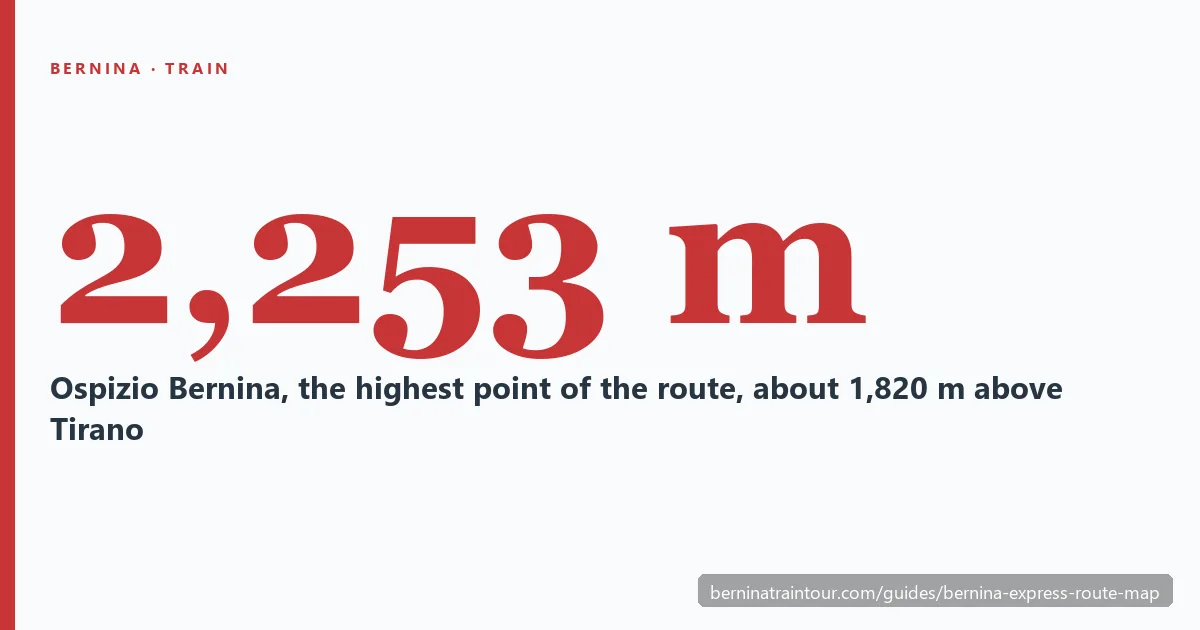
The Bernina Express runs about 145 km from Chur to Tirano in two parts. The Albula line climbs from Chur past Thusis, the Landwasser Viaduct and the Bergün loops to the Engadin. The Bernina line then runs about 61 km from St. Moritz over Ospizio Bernina, at 2,253 m the highest point of the Rhaetian Railway, and drops to Tirano at about 430 m.
Most day trips from Milan ride only the Bernina line, between St. Moritz and Tirano. The stop list below shows which tour covers which part.
Check Availability
The route at a glance
Think of the route as a long letter Y lying on its side. Chur trains climb the Albula line and join the Bernina line at Pontresina. St. Moritz trains start on the Bernina line itself. From Pontresina it is one track south over the pass to Italy.
The headline numbers belong to the whole Chur to Tirano run. RhB counts about 55 tunnels and 196 bridges along it, and the Bernina section reaches a gradient of 70 per mille (7%) without a rack. The Albula and Bernina lines have been a UNESCO World Heritage Site since July 2008, under the name “Rhaetian Railway in the Albula / Bernina Landscapes”. The UNESCO stretch is usually given as about 122 km from Thusis to Tirano.
Chur trains run to Pontresina without starting in St. Moritz, so if you want to board in St. Moritz, pick a St. Moritz departure or check your train’s stops in the SBB app.
Chur to St. Moritz: the Albula line
This is the half most Milan day trips never see. It belongs to the Chur-based Bernina Express trains, PE 951 and in summer PE 955, and to the ordinary trains between Chur and St. Moritz.
| Order | Stop or landmark | What to look for |
|---|---|---|
| 1 | Chur | Start of the Bernina Express. Trains from Zurich arrive here |
| 2 | Thusis | Where the UNESCO stretch begins |
| 3 | Tiefencastel | First Albula-line stop before the viaduct |
| 4 | Landwasser Viaduct | The curved stone viaduct, 65 m high, between Schmitten and Filisur, running straight into a tunnel in the rock face |
| 5 | Filisur | Station right next to the viaduct |
| 6 | Bergün to Preda | The line gains height through helical tunnels and loops, so you see the same valley from several levels |
| 7 | Albula Tunnel | New 5.86 km tunnel, in service since June 2024, under the pass to the Engadin |
| 8 | St. Moritz / Pontresina | St. Moritz station sits at 1,775 m; Chur trains continue to Pontresina |
The Landwasser Viaduct is on this Albula line, not on the St. Moritz to Tirano section. Our Chur to Tirano guide covers the full-route trains and tickets.
St. Moritz to Tirano: the Bernina line
This is the stretch everyone means by “the Bernina train”. It takes about 2 h 15 min on the Bernina Express and runs from glacier country down to the vineyards of Valtellina in one go.
| Order | Stop | Altitude | What to look for |
|---|---|---|---|
| 1 | St. Moritz | 1,775 m | Start of the Bernina line for St. Moritz trains |
| 2 | Pontresina | 1,774 m | Chur trains join here |
| 3 | Morteratsch | 1,896 m | Glacier valley; the Montebello curve, where the line meets the pass road, comes just after |
| 4 | Bernina Diavolezza | 2,082 m | Cable car to 2,978 m above the glaciers |
| 5 | Ospizio Bernina | 2,253 m | Highest point of the RhB network, beside Lago Bianco, on the watershed between the Danube and the Po |
| 6 | Alp Grüm | 2,091 m | Balcony station facing the Palü glacier and the valley below |
| 7 | Cavaglia | 1,692 m | The descent begins in earnest |
| 8 | Poschiavo | 1,014 m | Main town of the Val Poschiavo |
| 9 | Le Prese | 965 m | The line runs close to the road here |
| 10 | Brusio | 780 m | The spiral viaduct, where the train circles once to lose height |
| 11 | Campocologno | 553 m | Last stop before Tirano |
| 12 | Tirano | 429 m | Terminus in Italy; the train is reported to run at street level for its last stretch through town |
From Ospizio Bernina to Tirano the train loses about 1,820 m of height. The Bernina line opened in stages from 1908 and the full line on 5 July 1910. To pick the window that faces the glaciers, read which side to sit on.
Which section each tour rides
Day trips rarely cover the whole route. Here is what each one rides according to its listing:
| Tour | Section ridden | Train |
|---|---|---|
| Milan: Bernina train, Swiss Alps and St. Moritz day trip | St. Moritz–Tirano or reverse; St. Moritz–Thusis on some dates | Regional, 2nd class |
| Milan: St. Moritz and panoramic Bernina Express tour | St. Moritz → Tirano | Bernina Express panoramic coach on the panoramic option |
| Milan: Bernina red train and St. Moritz | Tirano → St. Moritz, can run reversed | Regional red train |
| Milan: St. Moritz with Bernina or Albula red train | Bernina line, or St. Moritz–Filisur with a Landwasser viewpoint on the Albula option | Regional |
| Milan: Bernina train with Diavolezza lunch | Bernina Diavolezza → Tirano | Regional, standard carriage |
| Tirano–St. Moritz return day ticket | Tirano ↔ St. Moritz, hop on and off | Regional red train |
The featured TaoTravel day trip (our breakdown) costs from $110 per person, is rated 4.8 from 1,650+ reviews and rides 2nd class with opening windows. It passes Lake Como and the Maloja Pass by coach and Poschiavo by train. On certain dates its train runs from St. Moritz to Thusis on the Albula line, so check the option you book.
Only the two Frigerio tours on this site, the Milan departure above (our breakdown) and its Como twin, put you in a panoramic Bernina Express coach. The Bernina Express tours comparison lines up all of them.
Landmarks people put in the wrong place
The Landwasser Viaduct is the usual mix-up. It sits on the Albula line near Filisur, so a tour that rides St. Moritz to Tirano does not cross it. If the viaduct matters to you, pick the Albula option of the City Wonders tour (our breakdown) or ride the full route from Chur.
The Brusio spiral viaduct is on the Bernina line, low in the valley above Tirano, and appears in almost every photo of the trip. The Morteratsch glacier and the Montebello curve come soon after Pontresina. Lago Bianco and Ospizio Bernina sit at the top, and Alp Grüm, with the Palü glacier view, is just below.
Coach legs add their own scenery. Many Milan tours drive over the Maloja Pass and along the Engadin lakes, which is road scenery, not part of the railway. The St. Moritz to Tirano page explains how that section works as a standalone trip.
Frequently asked questions
What are the main stops on the Bernina Express?
Chur, Thusis, Filisur and the Albula line to the Engadin, then Pontresina, Bernina Diavolezza, Ospizio Bernina, Alp Grüm, Poschiavo and Tirano. St. Moritz trains start at St. Moritz, and the regional red trains call at more of the small stations in between.
Is the Landwasser Viaduct on the St. Moritz to Tirano route?
No. The Landwasser Viaduct is on the Albula line between Chur and St. Moritz, near Filisur. You cross it on the Chur-based Bernina Express or on the Albula option of some Milan tours.
What is the highest point of the Bernina Express?
Ospizio Bernina, at 2,253 m, beside Lago Bianco. It is the highest point of the whole Rhaetian Railway network, and Tirano lies about 1,820 m lower.
How long is the Bernina Express route?
About 145 km from Chur to Tirano, of which the Bernina line from St. Moritz is about 61 km. The full ride takes a little over 4 hours, and St. Moritz to Tirano about 2 h 15 min. Times by train are in the timetable guide.
Does the red train follow the same route as the Bernina Express?
Yes, between St. Moritz and Tirano the regional red train uses the same track and passes the same landmarks. It stops at more stations and has windows that open. The comparison of the two trains covers the differences.
Check Which Train Your Tour Actually Uses
Most day trips from Milan ride the regional red train in 2nd class. Only some options guarantee a seat in the panoramic Bernina Express coaches.
Check Availability