The Bernina Express in Winter: What to Expect
The Bernina line runs all winter. St. Moritz gets about 8.5 hours of daylight in late December, so ride in the morning or at midday and dress for the cold.
The Bernina line runs right through the winter, as it has since 1913/14, and snow turns the high section into a white world of frozen lakes and buried stations. Plan around the light. St. Moritz gets only about 8.5 hours of daylight on 21 December, with sunset around 16:35, so a morning or midday train sees far more than a late-afternoon one.
Fewer panoramic Bernina Express trains run in winter, while the regional red train keeps its roughly hourly service. Most Milan day trips keep running too, including the Autostradale tour featured below.
Check Availability
The winter timetable
RhB’s winter timetable runs from 26 October 2026 to 23 April 2027, split by the usual mid-December timetable change on 13 December. In that period only a handful of panoramic Bernina Express trains run each day.
| Train | Route | Departs | Arrives | Runs |
|---|---|---|---|---|
| PE 951 | Chur → Tirano | 08:17 | about 12:50 | Daily |
| PE 975 | St. Moritz → Tirano | 15:30 | 18:00 | Daily |
| PE 977 | St. Moritz → Tirano | 16:14 | Check rhb.ch | Extra days only |
| PE 970 | Tirano → St. Moritz | 09:18 | 11:45 | Extra days only |
| PE 972 | Tirano → St. Moritz | 10:06 | 12:35 | Daily |
| PE 952 | Tirano → Chur | 14:24 | 18:31 | Daily |
The two extra trains run from 13 December 2026 to 23 April 2027 on Fridays, Saturdays and Sundays (plus 29 March 2027), and daily from 26 December 2026 to 5 January 2027. Times can shift, so check the Bernina Express timetable and rhb.ch before you book.
For daylight, the best panoramic choices are PE 951 from Chur, which crosses the Bernina Pass around midday, and PE 972 from Tirano, which climbs in the late morning. The 15:30 from St. Moritz reaches Tirano at 18:00, around or after dusk in November and December, so you see the high section in fading light and the lower valley in the dark. Northbound, PE 952 finishes its long run to Chur after dark.
If you ride from Chur, you also cross the Albula line and the Landwasser Viaduct before reaching St. Moritz. Our Chur to Tirano Bernina Express page covers that full route.
The regional red train is the flexible option in winter. It runs roughly hourly on the same track, so you can pick a departure that fits the light without booking days ahead.
Daylight and the afternoon problem
Winter days are short at this latitude, and the mountains make them shorter still once the sun drops behind a ridge.
| Date | Sunrise | Sunset | Daylight in St. Moritz |
|---|---|---|---|
| 21 December 2026 | about 08:00 | about 16:35 | about 8.5 h |
| 15 January 2027 | about 08:00 | about 16:58 | about 9 h |
| 21 June 2026, for contrast | about 05:27 | about 21:16 | about 15.8 h |
These are flat-horizon times, so the sun leaves the valleys earlier in practice.
The operators know this. Frigerio Viaggi notes in its own listings that from late October to late February, views from the train windows may be reduced in the afternoon because the sun sets early. That matters because many Milan day trips ride the train in the afternoon. From Milan: St. Moritz and Bernina Express Tour (our breakdown), for example, spends the morning in St. Moritz and boards the panoramic train in the afternoon.
Tours that ride uphill from Tirano earlier in the day tend to catch better light. From Milan: Bernina Train and St. Moritz Day Trip (our breakdown), from $160 with 4.5 stars from 5,070+ reviews, normally takes the coach to Tirano, rides the 2nd-class red train up to St. Moritz, and returns over the Maloja Pass. Like many tours it can reverse the order or switch to the St. Moritz–Thusis section on some dates, so ask which way your date runs.
Winter is not a gloomy season up here. The Samedan weather station near St. Moritz records about 102 hours of sunshine in December and about 120 in January, and a clear winter day on the pass is bright and sharp.
What the line looks like under snow
The Bernina line climbs from Tirano at about 430 m to Ospizio Bernina at 2,253 m, the highest point on the RhB network. In winter you ride through several seasons in two hours.
- Around Tirano and the lower Poschiavo valley, the ground is often bare or only lightly dusted.
- Above the Brusio circular viaduct and Poschiavo, the snow line arrives and the forests turn white.
- At Alp Grüm and Ospizio Bernina, the station buildings sit deep in snow, and Lago Bianco usually lies frozen and white across the pass.
- On the Engadin side, the Morteratsch glacier and the Bernina peaks rise above the valley floor.
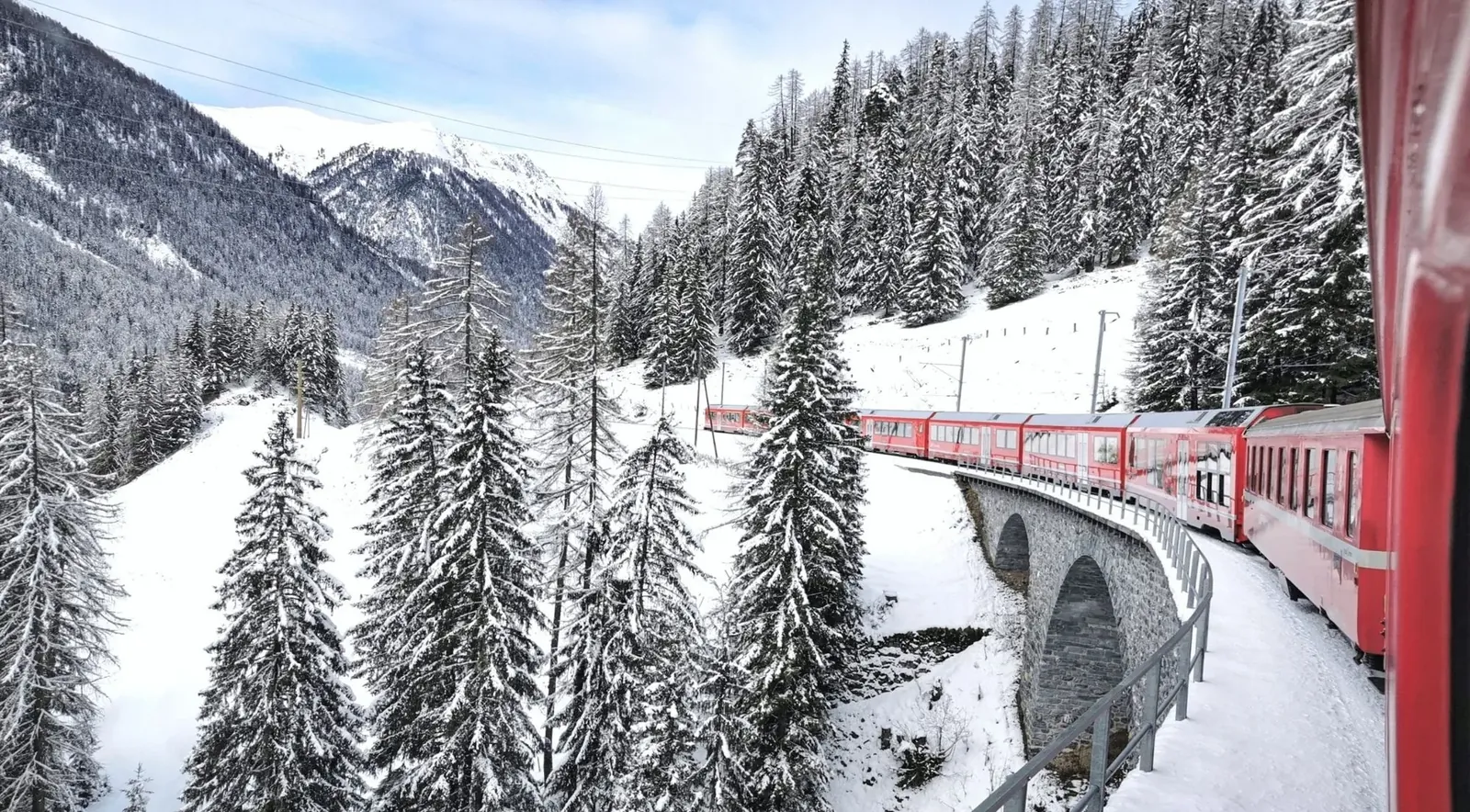
Snow changes how you take photos. The panoramic Bernina Express windows do not open, and bright snow can throw glare onto the curved glass. The regional red train has windows that open, though cold air at 2,000 m and more makes that a quick shot, not a long one. Neither train lets you choose a side, so see our best side to sit notes and the Bernina Express route map to know when the big views come.
Cold, altitude and what to wear
St. Moritz sits at about 1,822 m and the pass at 2,253 m, so dress for real mountain cold even if Milan feels mild. At the Samedan station, the 1991–2020 averages are about −0.7 °C for the December daytime high and −13.4 °C for the low. January is colder, at about −1.3 °C and −15.8 °C.
The tour operators say the same. The small-group listing from LUCAfromITALY asks winter guests to bring a heavy jacket, good shoes, a scarf and gloves, and Vaxvi Tour warns that the Swiss Alps can be very cold.
What to pack:
- A warm, windproof jacket and a layer you can take off on the train
- Waterproof shoes or boots with grip for icy streets in St. Moritz
- Hat, gloves and a scarf
- Sunglasses, because snow glare at altitude is strong
- Snacks and water, since many day trips leave little time for lunch
- Your passport or ID card for the border crossing at Tirano
Crowds, holidays and extra trains
RhB says weekends and public holidays are the busiest days on the line, and Monday to Thursday is quieter. The extra trains tell their own story: PE 970 and PE 977 run daily from 26 December to 5 January, the busiest stretch of the winter.
- Bernina Express reservations open for the whole timetable period, and popular dates sell out. Book the Christmas and New Year weeks early.
- The reservation from Chur is reported at about CHF 40 in winter and CHF 44 in summer, while St. Moritz–Tirano is reported at about CHF 32 all year. See Bernina Express ticket prices.
- RhB sells a winter offer: a return journey for two with lunch for CHF 249, from Chur to Poschiavo, Le Prese or Tirano, bookable from 1 November 2026 to 31 January 2027. It is non-refundable.
Holiday traffic also hits the coach tours. One December reviewer on a Milan day trip lost time on the roads, which came straight out of the free time. In St. Moritz itself, the frozen lake hosts events such as the White Turf horse races and snow polo, which bring crowds of their own. If you want to ride the morning train fresh, consider staying near the line for a night.
Which tours run in winter
When we checked on 11 November 2026, every major Milan day trip had bookable dates within the next week.
| Tour | From | Train | Winter note |
|---|---|---|---|
| Autostradale Bernina train day trip | $160 | Red train, 2nd class | Can switch to St. Moritz–Thusis |
| Milano Art Discovery red train day trip | $144 | Red train from Tirano | Not for children under 6 |
| Frigerio panoramic Bernina Express tour | $186 | Panoramic coach on that option | Afternoon train, warns of reduced light |
| City Wonders Bernina or Albula red train | $122 | Red train, no reserved seats | Choose the Bernina option for Tirano |
| TaoTravel Bernina train day trip | $110 | Red train, 2nd class | Can run St. Moritz–Thusis on some dates |
Winter reviews of the red-train day trips raise the same points as summer ones, plus a few seasonal ones: a train section shorter than expected, a newer carriage whose windows did not open, and late starts that cut the St. Moritz stop. Ask the operator about your date’s route before you go. Our Bernina red train from Milan page compares the day trips in full, and the Bernina express tours page ranks every format.
Frequently asked questions
Does the Bernina Express run in winter?
Yes. The Bernina line has run in winter since 1913/14, and the Bernina Express runs daily through the season with fewer trains than in summer. The regional red train runs roughly hourly all year.
Is the Bernina Express better in winter or summer?
Winter gives you snow, frozen lakes and quieter weekdays, but short days and cold. Summer gives you about 15 hours of daylight, green valleys and more trains, along with bigger crowds. If you want snow, go between December and March and ride before mid-afternoon.
Is the Bernina Express cheaper in winter?
Slightly, from Chur. The Chur–Tirano reservation is reported at about CHF 40 in winter against CHF 44 in summer, while St. Moritz–Tirano stays at about CHF 32. Tour prices quoted here were checked for mid-November dates, and the widget shows the price for your date.
Can I see the Landwasser Viaduct on a winter trip?
Only if you ride the Albula line between Chur or Thusis and St. Moritz. The St. Moritz–Tirano section, which most Milan day trips use, does not pass it. PE 951 from Chur crosses the Albula line before the Bernina line.
What should I wear on the Bernina Express in winter?
A warm jacket, waterproof shoes with grip, a hat, gloves and sunglasses. Average December lows near St. Moritz are about −13 °C, and the pass is higher still. Trains are a place to shed a layer, but the stops and St. Moritz streets are not.
Check Which Train Your Tour Actually Uses
Most day trips from Milan ride the regional red train in 2nd class. Only some options guarantee a seat in the panoramic Bernina Express coaches.
Check Availability